The idea to write this blog originated in 2019, when I was unable to find enough resources about living an ENM lifestyle as a millennial. As I began my journey to live ethically non-monogamous, I had so many different learning experiences and opportunities for growth. At that time, all I’d be able to write about were my experiences – which aren’t all great examples of healthy ENM. I decided to move ThePolyamorousMillennial to the back burner until I felt that sharing my journey and experiences would actually benefit the reader.
Fast forward to December of 2021, and I was finally ready. I was in an incredible place, I’d undergone immense growth, and I was finally feeling like I had something to offer the millennial ENM community. I was in several, long-term, successful ENM relationships, and I was feeling the security that I needed to be able to attempt to share my journey.
On December 26th, 2021, my world was shaken when one of my partners chose to dissolve our relationship. Not only was it my hardest breakup since becoming polyamorous, it was the hardest breakup I’ve ever experienced in my 32 years of life. The almost two years spent in this relationship provided both my partner and I with immense growth and ENM learning opportunities. We worked through issues when they arose, and we communicated openly and freely about everything. We learned what it meant to be wholeheartedly committed to someone in a non-primary, non-nesting partner role. We overcame issues with insecurities and emotions of jealousy. We loved each other fiercely and passionately. I will forever remember our relationship as a healthy example of KTP.
When he and I first met, we were several months into the COVID-19 pandemic. Perhaps due to the constraints of the world to avoid contact with the public, we spent our date time at home, enjoying our shared hobbies with each other. Things progressed at rapid speed and we quickly intertwined our lives as much we could being non-nesting partners. Being a part of our COVID bubble, he and his nesting partner spent several holidays with my husband and I throughout 2020. As vaccinations rolled out and distancing guidelines were relaxed, we began to add other partners to our lives. He and I worked through insecurities that arose on my end from him spending less time with me and more time with new relationship partners. We could have gotten through anything. We respected each other’s boundaries and we didn’t place rules on each other, it was the perfect example of a healthy polyamorous relationship.
So why did it end? It’s taken me roughly 2 weeks to process and come to understand. Through no fault of either of us, he came to realize that he’s not at a place where he can handle multiple romantic relationships. When we met, he and his nesting partner were still pretty new to ENM. They knew they wanted to explore relationships with others, but they weren’t sure to what capacity. Through my own journey, I learned that I do not like casual sexual relationships. I need a romantic connection with my partners to have fulfilling sexual relationships. When he and I started our relationship, we both just let it evolve on its own. As I mentioned, it grew into the loving, passionate relationship it was over the course of a year and a half. As he came to be more in-tune with his own sense of self and his own needs, he sadly realized that he was unable to sustain multiple romantic relationships of that caliber, which is why, as painful as it was to both of us, he needed to dissolve the relationship we had created.
The reason I’m taking time to write about this is to let it be known that sometimes – good relationships come to an end. Prior to this breakup – I had the belief that relationships only ended if things were notably not working. For both of us, this relationship worked for us for a long time, and although nothing inherently changed, there came a time where this chapter needed to close. While it was still meeting my needs and working for me, it was no longer working for my partner. And as hard and as sad as it is to see things come to an end – relationships ending are okay.
Growing up in a mononormative society – I had the belief that for a relationship to be successful, it needed to last forever. Being polyamorous – I’m starting to learn that a) it’s physically impossible for all relationships to last forever, and b) just because a relationship doesn’t last forever doesn’t mean it wasn’t a successful relationship.
Yes, it absolutely sucks when you feel a certain way about someone and they don’t feel the same way back.
Yes, it absolutely sucks when a relationship is meeting your needs completely but on the flip-side, it isn’t meeting your partner’s needs.
Yes, it absolutely sucks when a relationship you perceive as being healthy and strong needs to dissolve because it’s no longer working for your partner.
But life is about growth. I still have an immense amount of love for this partner. After I’ve experienced the emotions of grief and sifted through my feelings of heartbreak, I can honestly say that I still want the best for him, because of the amount of love I have for him.
As I sit down to write this post, I have healed enough that I’m trying to portray it in the most objective way possible. Getting to this point didn’t happen overnight. Suddenly this person that I’d grown accustomed to talking to everyday, who I’d spent large amounts of quality time with at least once a week for the past 82 weeks was no longer able to fill that role in my life. My metamour was now no longer my metamour, and being a person who loves labels, that was devastating for me. My metaroommate (can we make this a thing??) was no longer my metaroommate. My metapets were no longer my metapets. Would I ever be able to bring myself to finish the shows he introduced me to that we watched together? (Nobody spoil Game of Thrones or Parks and Rec for me in the meantime, just in case I decide to finish them…) Would I ever bring myself to play Skyrim again? (It’s not just as easy as buying my own copy and starting fresh because his version was heavily modded, and now I’m spoiled.) Would I ever find someone else to be as comfortable with exploring the different facets of my sexual needs? There’s a whole other layer of grief that that comes from the loss of a D/s dynamic. On top of all the pain from loss that comes from a breakup, my attachment style leans heavily towards Anxious/Preoccupied Attachment, so I internalized it all, convincing myself that it was because of something I must have done, rather than accepting the reasoning my partner communicated to me.
Understanding why my partner needed to dissolve our relationship was not easy. For days/weeks I felt blindsided because to me, it came out of nowhere. Could we have communicated a bit better leading up to this point about my partner’s evolving feelings? Definitely. However, ultimately the pain and loss were going to happen regardless because an important, multi-year, highly entangled relationship was coming to a close. As he started becoming more attuned to his own changing needs, he tried putting it off because he cared so deeply for me and the relationship we’d created over the past year and a half. However, at the end of the day, for him to live congruently with who he was in his core, he needed to move on to grow into the person he was becoming, and that didn’t include a romantic relationship with me.
Things that have helped me cope with the loss of this relationship:
- Allowing friends/other partners to give me support
- For the first few days, I couldn’t stop crying and all I wanted to do was stay at home, curled up in bed (thankfully I was off work, on holiday vacation and staying home was an option). However, being alone, my thoughts were occupied solely by reminiscing and sadness.
- While this is necessary to an extent, don’t allow it to be 100% of your time. Spending time with others who love and support you will give your mind a temporary distraction and allow you to get your mind off the loss for at least a little bit.
- There were times I couldn’t stop crying and a friend came over and just sat with me while I cried, and to be honest, it felt better than sitting at home alone, crying all by myself.
- *Note* that not all friends/partners are great at giving support, and that’s okay. Some individuals are inherently more empathetic. For me, NP is not the best person to turn towards when I need emotional support because he doesn’t do well in situations of high emotional stress.
- I can laugh about it now, but his method to try to help me feel better was simply saying “yeah it sucks now but in a few months you’ll be alright” *pat pat*
- Because I’ve been with him 9 years, I understand that he was legitimately trying to help, but we have different attachment styles and that comes out in his attempts to be supportive during hardships.
- Allow yourself to be surrounded by the people in your life who are good at supporting through hardships, and try not to take it personally when some people aren’t as good at supporting you as others.
- One of the worst things to hear was “well it’s not so bad because at least you have other partners” from various monogamous folk
- Heartbreak is heartbreak. Loss is loss. If a parent loses a child, society doesn’t tell them: at least you have another one.
- I can laugh about it now, but his method to try to help me feel better was simply saying “yeah it sucks now but in a few months you’ll be alright” *pat pat*
- For the first few days, I couldn’t stop crying and all I wanted to do was stay at home, curled up in bed (thankfully I was off work, on holiday vacation and staying home was an option). However, being alone, my thoughts were occupied solely by reminiscing and sadness.
- If friends/other partners aren’t available, find something to focus on/be a distraction
- For me, I struggle with diagnosed anxiety and depression anyway and prior to the breakup, I had been in a downward spiral where I wasn’t keeping up with my household chores. To get my mind off the feelings of sadness, I cleaned my room. It ended up being a few hours where, for once I wasn’t ruminating on all I was losing with the end of the relationship
- I also started a new hobby of needlepoint embroidery. If I noticed I was getting particularly sad or spirally, I would spend an hour or two on my embroidery project.
- Avoiding talking to the partner with whom the relationship had ended (not permanently, but temporarily as you grieve)
- I found that when I tried to talk to him, I displayed some unhealthy behaviors
- I tried reasoning with him to reconsider
- I lashed out in anger and said things I didn’t mean
- Each time we talked I was reminded that the relationship was, in fact, over and it was like a new wound was created each time
- For me, it was best to give that partner some space away from communicating
- I found that when I tried to talk to him, I displayed some unhealthy behaviors
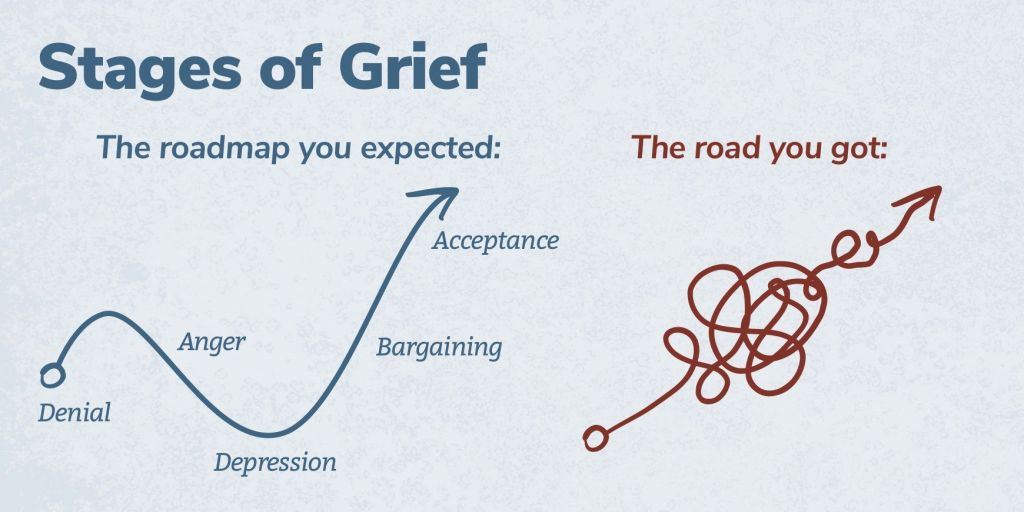
- Take the time you need to grieve and understand that it won’t be a linear process
- Yes, I mentioned spending time with your support system even when you didn’t feel like it, but you will still need to spend some time grieving the loss.
- Getting over heartbreak isn’t directly related to the amount of time that has passed. It’s not a given that 1 week after heartbreak will be easier than 2 weeks after
- Grief comes in stages: denial, anger, bargaining, depression, and acceptance. Each of the 5 stages will likely throw you for an emotional loop, and you may move backward and forward through stages over time, so remember to be patient and be kind to yourself as you heal
Ultimately, I wanted to take time to address what’s been going on because it had been a while since I published a post and I wanted you to know why. By sharing, I’m hoping that if anyone finds themselves in a similar situation, that hopefully this can be a small piece that helps with healing.
The past year and a half with this person as my partner taught me so much, and I believe it taught him a lot too. I’m still grieving the loss that comes from the relationship ending, but that’s normal and necessary. Once the pain and grief subside, I’m hopeful that we can remain as close friends in each other’s lives.
As I start to adjust to this new normal, I hope to begin writing again more frequently. Thank you for your patience and support in the meantime.
In what ways has being polyamorous made breakups harder for you? In what ways has it made it easier?
 The Polyamorous Millennial
Thanks for posting your thoughts while going through your breakup. I’ve been through several “no-fault” ones. The painful experience didn’t decline with each successive one but I gained more insight and a better sense of detachment over time. I have no regrets for having lived in poly relationships with my partners. Also keep in mind that you may reunite with some of your “exes” so try to stay calm and avoid burning any bridges.
LikeLiked by 1 person
So glad you were able to gain more insight with each breakup experience? I’m hoping I’ll be able to do that too, despite how painful they are. Like you, I don’t regret any of the time I spent in a relationship with this partner. To your point, I’m finding that the relationships I have with my poly exes have been much different than the exes I had when I was monogamous. It’s much less “I hate this person, I’m never talking to them again” and a lot more “our relationship didn’t work out right now, but maybe things will change in the future.” I actually had a partner once who just was going through some stuff and so we ended our relationship so he could work on himself, and a little over a year later he reached back out and we picked things back up. It was really nice.
LikeLiked by 1 person
That’s an interesting observation of the differences between mono & poly exes. I haven’t been in any mono relationships that lasted very long so I can’t speak for those kind of breakups. However, with the ‘pandemic’ winding down (who knows for sure) many of my poly exes are returning and it’s like we’re picking up where we left off. Poly relationships seem to be deeper than the mono ones (although I have little experience on the mono sides). I hope things can work out for you now that we’re returning to the way things were.
LikeLiked by 1 person
Happy to say that now 2 months out from this breakup, things are happy and flourishing with my other relationships 🙂 I was mono for the first 29 years of my life – though wishing I would have been clued into polyamory much sooner. I think you’re onto something RE: poly relationships being deeper. The best way I can describe it is that my mono relationships were all structure-based. I strive to make my poly relationships experience-based – I think you’re right. They’re deeper….perhaps because the partners I have aren’t with me out of obligation or structure, they’re with me because they continue to choose to be. And I think that’s beautiful 🙂
LikeLiked by 1 person
I also believe poly rels. typically have more communication & consent since there are no easy hierarchies & division of labor that we find in mono ones, especially with tradition-oriented couples. I believe Dr. Scheff noted this in both of her books. How did you adapt to the transition from mono to poly? Dr. Scheff mentioned that she tried a poly with her husband and returned to a mono one. Most women I’ve met who transitioned to poly were glad to leave a mono situation (and often their former spouse) particularly when children were involved. Could this be the burden of bringing up children? Or the need for better parenting quality ?
LikeLiked by 1 person
I think you’re right on the nail with the communication realization. Like the women you mention, I was glad to leave my mono situation. NP and I are still happily partnered, though living as un-hierarchical as we can as a married couple. I don’t have kids, so for my situation it’s nothing to do with that, but I think it’s probably to do with just having more opportunities to have different needs met by my different partners. As time has elapsed it’s become evident that being poly is really who I am in my core.
LikeLiked by 1 person